Two travelers arrive in an electromagnetic universe. The very first structure they meet is a corridor that won't explain itself without a fight — one curl equation at a time.
The universe arrived as motion before it arrived as anything else.
Kira felt it first — not a hum sitting still, but something travelling, sliding lengthwise past her like current down a wire. Then the shape resolved: a cylinder, hollow, open at both ends, curving away into the dark in either direction. No caps. No seams. Just a long metal throat with something moving through it, endlessly, toward wherever "forward" was.
It's not sitting still. Whatever this is, it's carrying something — I can feel it passing through, not just sitting here ringing.
Voss was already crouched at the wall, running a bare hand along the curve of it, feeling for a seam that wasn't there.
One conductor. No cap, no second wall — just this, open on both ends. Before we say one more word about what's moving through it, I want to know what shape it's even allowed to take.
He straightened, already naming things out loud the way he did when a problem needed a foothold before anything else.
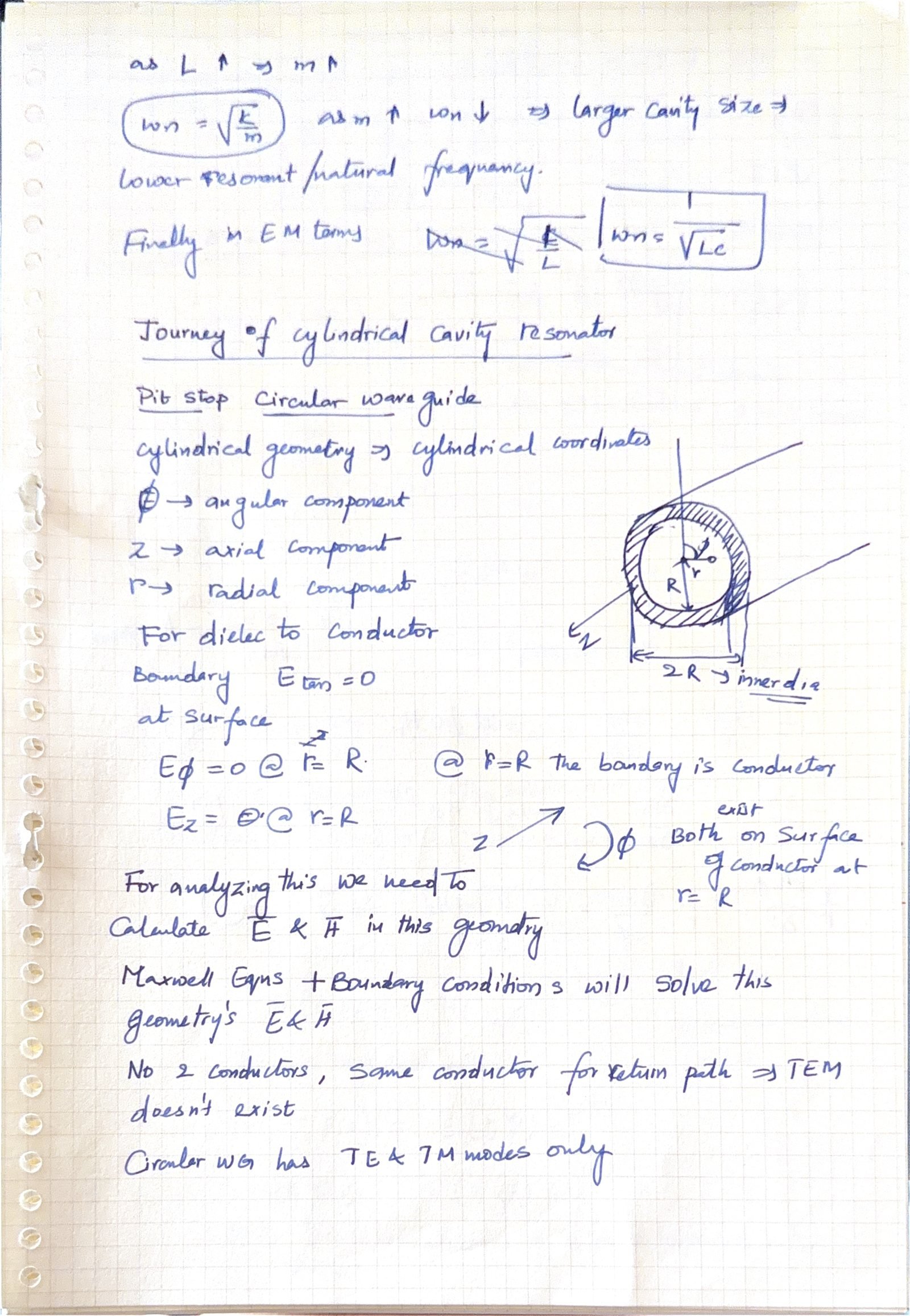
Cylindrical. So cylindrical coordinates — r for how far from center, φ for the way things turn, z for the way things travel. And at that wall—
Something has to end there. A field can't just stop, mid-air, at a conductor.
It doesn't stop. It's forced to zero — the part of it that runs along the surface. Tangential E, gone, right at r = R. That's not a guess. That's the one law this whole corridor has to obey, no exceptions. Everything else we find is going to have to fit inside that single rule.
Kira looked down the corridor's length, into the dark it kept sliding toward, and understood before he said it that this was going to take longer than a glance.
Which means Maxwell. Properly. Both curl equations, all three directions, no shortcuts.
He crouched at the boundary and started sketching the two equations that would have to carry the entire corridor on their backs.
This is the long way through — the full derivation, in the order it was actually worked out, wrong turns included. No skipped steps, no borrowed textbook shortcuts.
Strip the corridor down to its plainest description: a hollow metallic cylinder, open at both ends, with nothing at all filling the inside but the field itself — air, dielectric, or vacuum. A wave is launched in at one end and travels down the length of it, along z. There is exactly one conductor: the outer wall. That single fact is going to matter more than it looks like it should.
Maxwell left four equations behind. Inside this corridor, two of them contribute nothing new, and it's worth seeing exactly why before discarding them.
The interior is hollow — air, dielectric, or vacuum, never a conductor — so there's no free charge sitting inside to source field lines from. No free charge means ρ_v = 0, which forces ∇·D = 0 directly. ∇·B = 0 needs no excuse at all; it's simply always true, charge or no charge. This is a source-free, homogeneous region, and in a source-free region, the two divergence equations carry zero new information — they're automatically satisfied by any valid field, and solving them tells you nothing you didn't already know.
Cylindrical geometry means the curl has to be expanded in cylindrical coordinates — the determinant form, with the 1/r weighting that r, φ, z each carry:
Expanding that determinant term by term — r component first, then −φ, then +(1/r)z — and setting the result equal to −μ ∂H/∂t gives three scalar equations, one per direction:
(∂/∂t has already been swapped for jω — the standard phasor move: a wave assumed sinusoidal in time turns every time-derivative into a multiplication by jω. Same operation the Fourier transform does, just written the engineer's way.)
Ampère's law gets identical treatment — same determinant, same expansion, E replaced by H, μ replaced by ε, and the sign convention flips because Ampère's law carries no leading minus sign:
The general phasor form for a wave travelling in z, lossless medium assumed (so the attenuation part of γ = α + jβ drops out, α = 0), is:
Replace every ∂/∂z in equations (1)–(6) with −jβ, and the six curl equations stop being differential equations in z entirely — they become plain algebra in r and φ, tied together by this one constant.
Equations (2) and (4) are orthogonal in direction, so they pair naturally. With ∂/∂z replaced by −jβ, equation (2) becomes:
Substitute that into equation (4) to eliminate Hφ entirely — and this is exactly the step where the first wrong turn happened: a stray sign slipped through, the algebra briefly insisted Er depended on itself in a way that couldn't be simplified, and the only way through was to stop, retrace the substitution term by term, and redo it. That correction is part of the derivation, not a footnote to it:
Clearing the bracket and collecting terms, Er resolves to:
One quantity has now appeared twice in this same denominator, refusing to be ignored: ω²με − β². That quantity gets a name of its own before going any further.
Call it kc² = ω²με − β². Not an arbitrary label — an accounting identity, and it's worth seeing the bookkeeping behind it rather than just accepting the definition.
In an unbounded medium, a wave has exactly one number describing how compressed it is in any direction — the medium's own wavenumber, k² = ω²με. Treat that as a fixed budget: for a given frequency ω and medium (μ, ε), the wave has exactly this much spatial oscillation to spend, no more, no less.
Inside the corridor, the wave can't spend that whole budget moving forward. Some of it — β² — is committed to travelling along z. Whatever remains has to be spent on the field's shape across the cross-section, in r and φ. That leftover amount is kc²:
The same elimination process — pair the matching r/φ equations, substitute, cancel, collect around kc² — runs three more times: equations (1) & (5) resolve Eφ, equations (7) & (8) (the phasor-updated forms of (2) & (4)) resolve Hφ, and equations (9) & (10) resolve Hr. Each pass hits the same kind of algebra, and more than one of them needed a second attempt before the signs sat right. The four final results:
A TEM wave, by definition, has no longitudinal field at all — Ez = 0 and Hz = 0, everywhere. Set both to zero in the four boxed equations above and look at what happens to every single one of them:
The proof works — but it's worth understanding why, physically, not just accepting the algebra.
We already know, from fundamentals, that H is always in a loop — closed on itself, no beginning, no end. And E always runs from a positive charge to a negative one.
If H is looping around the corridor's cross-section, then E has to be perpendicular to H — that rule never bends. But inside a hollow metal tube, there is no potential difference anywhere to give E somewhere to run to. E has no choice: it has to curl and close on itself, just like H does.
Cross the boundary into a coaxial line — two conductors, inner and outer, separated by dielectric — and every constraint above disappears.
The inner conductor sits at a different potential than the outer one — a genuine potential difference exists between them, something the hollow single-conductor corridor never had. That potential difference drives an E field pointing straight out, radially, from the inner conductor to the outer one. It doesn't loop in on itself; it doesn't need to. It runs in one direction, inner to outer, exactly the way a potential difference is supposed to drive a field.
Because there is a potential difference, current flows in the conductors, forming a magnetic loop around the center conductor — H, closed, no z-component required of it either. Neither field is forced to curl along z, because neither one is trapped without somewhere to go the way they were in the hollow tube.
Every transverse field in this corridor now has a name, built from exactly two seeds — Ez and Hz — and one exchange rate, kc², whose entire meaning turned out to be leftover budget: whatever the wave didn't spend moving forward. And the corridor's single conductor turned out to be the whole reason TEM can't survive in it — not a limitation of the math, a limitation of the geometry itself.
But Ez and Hz are still just names. Nothing has actually pinned down what they are yet — and until something does, none of these four equations can be evaluated as an actual number, an actual field, an actual design.
Two seeds, still unplanted. Somewhere just ahead, one of them is about to be set to zero on purpose — Hz, silenced — while the other, Ez, is finally allowed to exist and take on a shape of its own. That single assumption is a mode. It has a name. And naming it is where the next leg of this corridor begins.
Everything above — the curl equations, the phasor substitution, the kc² ledger, the TEM proof, the coax comparison — was worked out first by hand, on paper, derivation by derivation, corrections and all. These are those actual pages.